Developer RSS Feeds
Aggregate engineering blogs, changelogs, advisories, package updates, podcasts, and custom sources without scraping every page.
Map feed sources →DevRSS.com maps the architecture behind developer RSS feeds, RSS-to-JSON APIs, release monitoring, webhook subscriptions, and portable content pipelines.
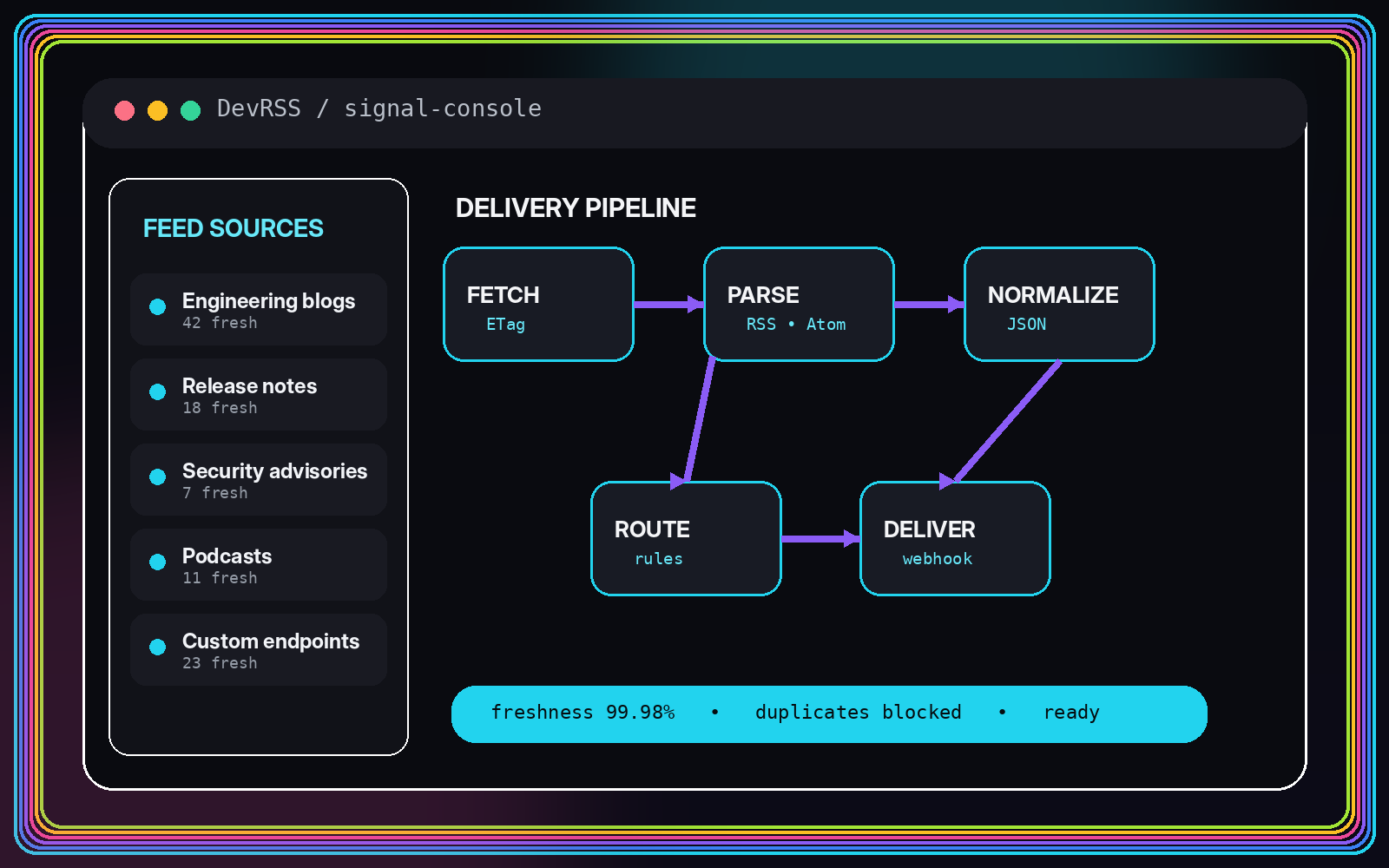
Use open syndication formats as a durable boundary, then add the controls required for production systems.
Aggregate engineering blogs, changelogs, advisories, package updates, podcasts, and custom sources without scraping every page.
Map feed sources →Normalize mixed feed formats into a stable schema with source identity, freshness metadata, warnings, and cursor-based history.
Review API design →Separate reachability, validity, content freshness, and delivery health so alerts point to the real failure stage.
Build monitoring →Use WebSub and signed webhooks for low-latency delivery while polling remains the reconciliation path.
Design subscriptions →Turn release objects, CI evidence, and deployment milestones into a curated team feed instead of another event firehose.
Model releases →Guard outbound HTTP, parse XML defensively, sanitize content, preserve provenance, and enforce idempotency at every stage.
Read architecture guide →A staged design makes failures explainable and lets each part scale independently.
{
  "id": "itm_01J...",
  "source_format": "atom",
  "title": "Version 4.8.0",
  "canonical_url": "https://...",
  "date_published": "2026-10-20T09:00:00Z",
  "first_seen_at": "2026-10-20T09:04:31Z",
  "change_type": "created"
}
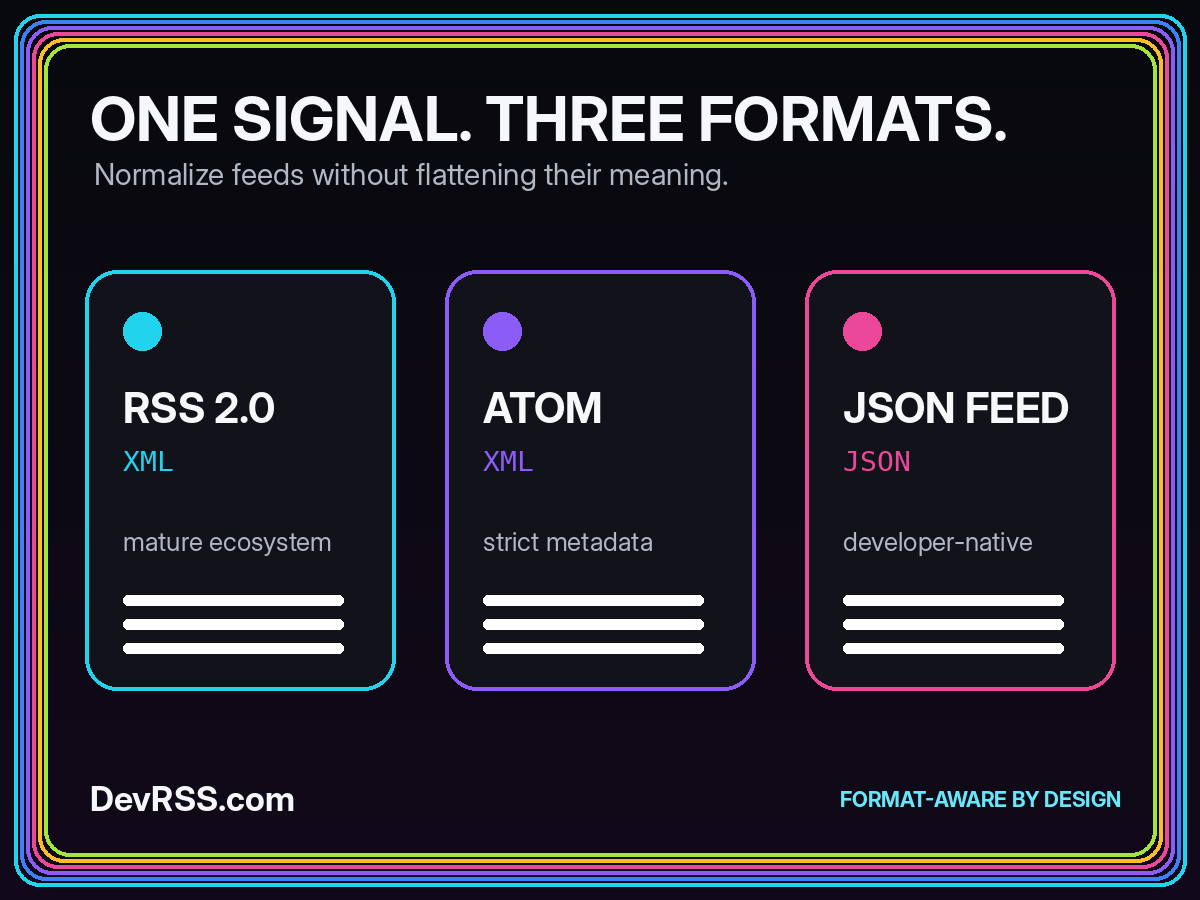
RSS maximizes compatibility, Atom adds precise identity and link semantics, and JSON Feed gives JSON-native clients a direct representation.
DevRSS.com treats format support as an adapter concern. The core pipeline works with stable entry identity, canonical links, publisher dates, observation times, content, authors, tags, attachments, and extension data.
Long-form implementation guidance grounded in open formats, HTTP behavior, safe ingestion, and production operations.
Plan tenant isolation, source governance, pagination, webhooks, analytics, retention, and service levels for a commercial feed platform.
Scale feed polling with conditional requests, adaptive schedules, host fairness, deterministic identity, and replay-safe processing.
Publish a durable podcast feed for technical shows with stable GUIDs, streamable enclosures, accurate metadata, and migration-safe URLs.
A repeatable debugging workflow for malformed XML, namespaces, dates, identifiers, redirects, content encoding, and validator warnings.
Create a stable release-intelligence stream from repository releases, tags, build results, and deployment events without flooding engineering teams.
Build monitoring that distinguishes source outages, stale feeds, parser regressions, duplicate entries, and downstream delivery failures.
A developer RSS feed is a machine-readable stream of engineering updates such as releases, changelogs, security advisories, documentation changes, or technical articles. It gives tools a stable way to discover new items without scraping presentation markup.
Yes. A format-aware adapter can preserve each source's identifiers, links, dates, content, and extensions while mapping common fields into a canonical internal model. Provenance and source-specific data should remain visible.
Use conditional requests and adapt the interval to source history, product requirements, and publisher capacity. Add jitter and host-level limits instead of checking every source on the same fixed schedule.
Not completely. WebSub or first-party webhooks can reduce delay, while periodic polling provides reconciliation when a lease expires, a notification is missed, or the publisher changes infrastructure.
Guard outbound requests against server-side request forgery, limit redirects, bytes, decompression and time, parse XML safely, sanitize embedded HTML, isolate credentials, and make every delivery idempotent.
No. This static site has no data-entry forms or account system. For project inquiries, use the visible email link at [email protected].
Use open feed formats for distribution, then add deterministic normalization, monitoring, and replay-safe delivery.