Engineering blogs
Track architecture posts, incident retrospectives, tutorials, and team updates with stable article URLs.
Design the architecture →Aggregate technical updates into a durable, inspectable stream without coupling every publisher to a proprietary integration.
A feed layer can unify many source types while preserving the canonical page as the source of truth.
Track architecture posts, incident retrospectives, tutorials, and team updates with stable article URLs.
Design the architecture →Normalize version announcements, migration notes, package updates, and release assets into a consistent stream.
Model release feeds →Route high-priority advisories while retaining publisher identity, timestamps, revisions, and canonical references.
Monitor critical feeds →Detect substantive documentation changes and group them by product, section, or audience.
Normalize source data →Publish and monitor episode feeds with stable GUIDs, enclosures, artwork, and migration-safe URLs.
Review podcast RSS →Compose filtered views for products, teams, tenants, environments, or topics from one canonical history.
Plan syndication →A useful record separates what the publisher said from when your platform observed it.
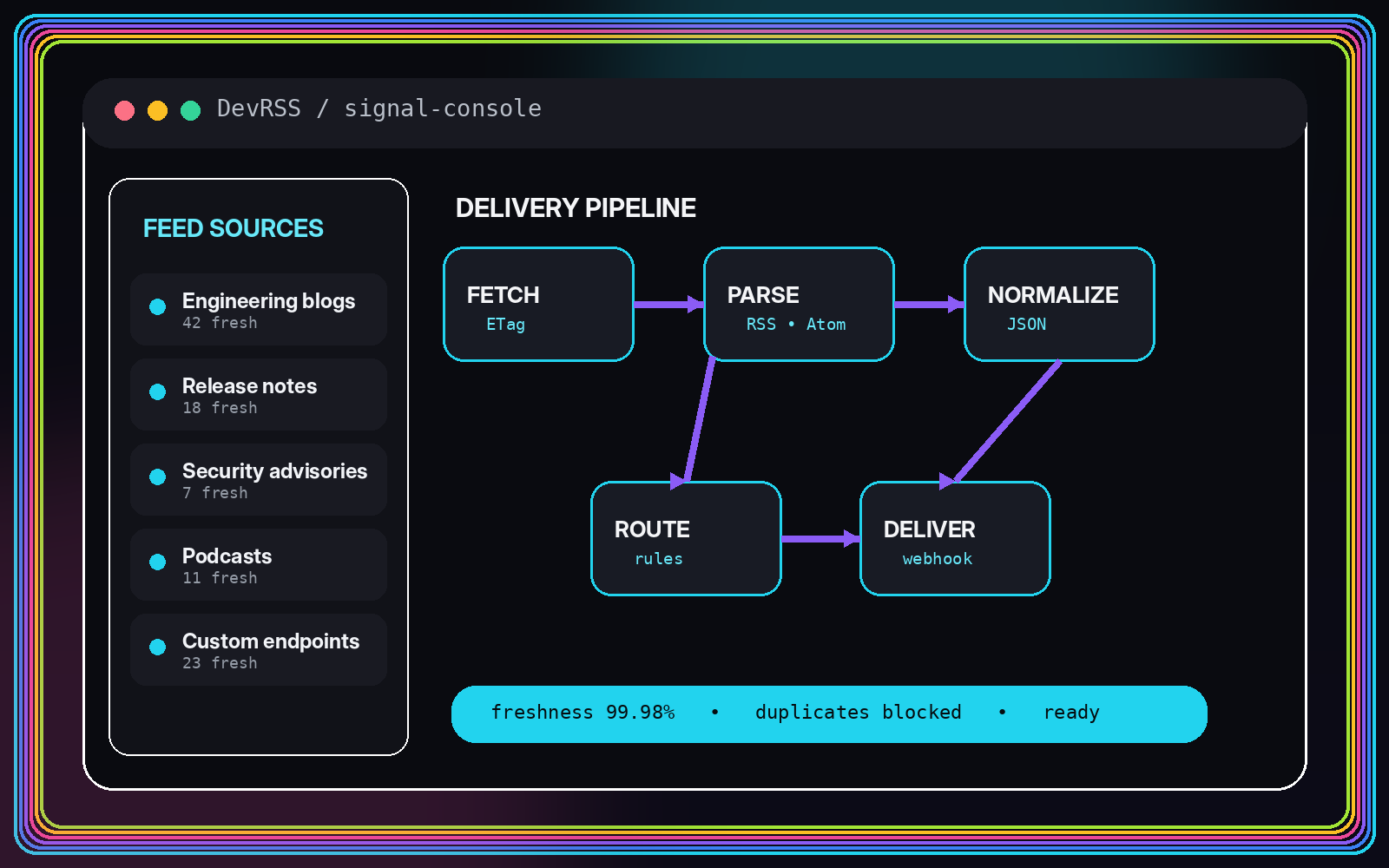
Validate the destination, cap redirects and bytes, use conditional requests, and retain response evidence.
Scale polling →Detect RSS, Atom, or JSON Feed, parse safely, resolve links, and preserve extension data.
Compare adapters →Apply documented precedence rules for IDs, dates, content, authors, tags, and attachments.
View API schema →Write entries and change events durably, then measure discovery lag and parser warnings.
Design observability →Match tenant filters, enqueue signed events, retry idempotently, and expose replay controls.
Design delivery →Offer current views, cursor-based history, and retention that is explicit to every consumer.
Plan B2B APIs →Engineering blogs, changelogs, releases, package updates, documentation changes, security advisories, technical podcasts, standards updates, and curated internal publications all fit when they have stable identity and canonical links.
Store enough raw response evidence to reproduce parsing and investigate incidents, subject to retention and privacy policy. The normalized model should not be the only record of how a source was interpreted.
Keep the item identity stable, compare a content fingerprint, update the normalized record, and emit an update event only according to subscriber policy.
Define accepted formats, identity precedence, freshness semantics, safety limits, and delivery behavior before choosing a parser library.